
Electronics
The first electronics were an important milestone. This page preserves recorded components and leaves future control-system details open until confirmed.
First servo testing
The existing Robotics journal records six Feetech STS3215-C018 serial-bus servos, two FE-URT-2 interface units and an initial 12 V, 30 A power supply.
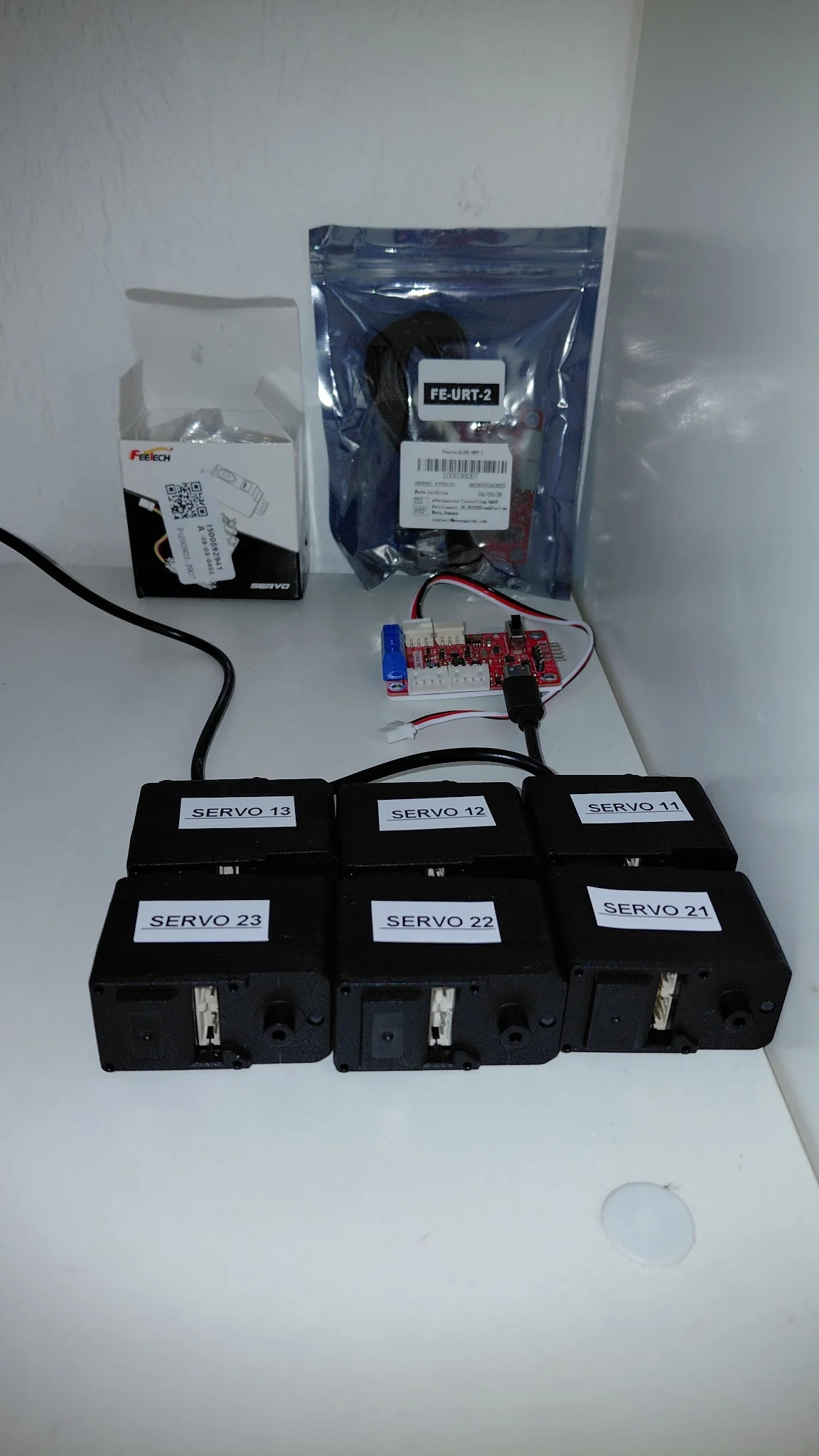
Servo address plan
The original servo identification list assigns 11 / 12 / 13 to the left ankle / knee / hip and 21 / 22 / 23 to the corresponding right-side joints. These are historical records, not a claim that the complete robot is operational.
Recorded specifications
The earlier website listed 4–14 V operation, 30 kg·cm peak torque at 12 V, 360° / 4096 steps, and position/speed/electrical feedback for the STS3215-C018. Confirm critical values against manufacturer documentation before design decisions.
Electronics roadmap
A Raspberry Pi 5, ESP32-S3, IMU, pressure sensors, ADCs and audio/video components were discussed as potential additions. Procurement and integration have not been verified for this website.
Servo technical reference
Specifications transcribed from the original Robotics website; verify against official manufacturer documentation before engineering use.
| Model (historical listing) | ST-3215-C018 / STS3215-C018 |
|---|---|
| Operating voltage | 4–14 V |
| Peak torque at 12 V | 30 kg·cm |
| Rated torque at 12 V | 10 kg·cm |
| No-load speed at 12 V | 0.222 seconds / 60° |
| No-load current at 12 V | 180 mA |
| Stall current at 12 V | 2.7 A |
| Rotation range | 360° (0–4096 steps) |
| Feedback | Position, speed, voltage, current, load |
| Protocol | Half-duplex asynchronous communication |
| Communication rate | 38,400 bps – 1 Mbps |
| Dimensions | 45.2 × 24.7 × 35 mm |
| Weight | 55 g |